
About
We believe knowledge should be cheap, accessible, and honest.
SchoolIT exists to help every student learn at their own pace, every teacher teach without drowning in paperwork, and every grade mean exactly what it says.
Our story
I'm a teacher. I love teaching — genuinely, not as a line on a resume. But the moment that shaped SchoolIT didn't come from a classroom of thirty. It came from one student.
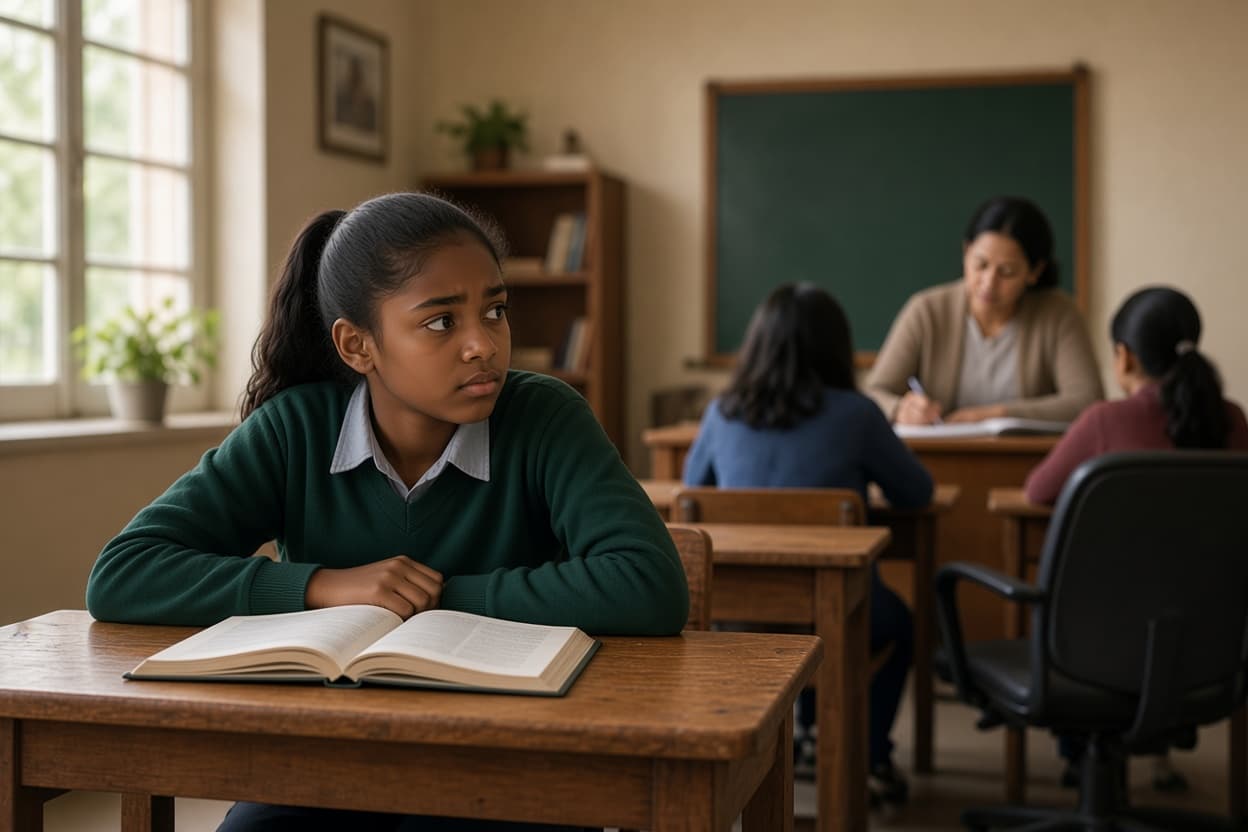
I was brought in to help a girl who couldn't read. It wasn't easy — she forgot almost as quickly as she learned, and some days it felt like starting over. But I noticed something: she loved the reading itself. Every time she read, she picked up new words. The problem wasn't her ability to learn — it was that she could only move as fast as I could sit beside her. Every new word she didn't know, she had to wait for me.
That bottleneck stayed with me. What if she didn't have to wait? What if she could keep reading, keep discovering new words, without a teacher physically next to her every time?
 Before
 After
AfterThat question became the Learning Centre — a place where authors publish books, and students with no prior help can read on their own, supported by the app itself instead of by whoever happens to be free that hour. And once I saw how much independent practice could do, I didn't stop there: for schools that already have lesson notes and a scheme of work, the app now turns that material into flashcards automatically, so studying doesn't have to wait for a teacher either.
That was the part of teaching I loved. The rest of it — setting exams, grading stacks of scripts, doing it all over again for every subject you teach — I didn't. And I quickly learned I wasn't alone. Almost every teacher I knew carried the same weight.
I went looking for something to lighten it and found exactly one free option: Google Forms. I used it for a while. It helped, but it was built for surveys, not schools, and I kept running into its ceiling. So I decided to build my own.
It started small — just a way to run an exam. Then I realized results needed somewhere to live, so I added reports. Teachers could reuse questions instead of retyping them every term, and grading got easier — but only for multiple choice. Essays still meant reading every single one by hand.
That's when the goal changed. I stopped trying to eliminate the work and started trying to aid it instead. The system began generating questions, not just storing them. And it learned to grade essays too, not just tick boxes.
Somewhere in that process, I ran into a harder problem than workload — one about trust. I'd seen it myself and heard it from other teachers: some inflate grades to avoid trouble with their bosses or to keep students happy. Others under-grade, not out of malice, but because grading well is genuinely hard to do consistently across a hundred scripts. Either way, the grade stops meaning what it's supposed to mean.
So I built guardrails around it. Every AI-generated question goes through an admin for approval before it reaches a student. Once a grade is recorded, it can't just be quietly changed or deleted — a teacher needs their admin's permission first. None of this is about distrusting teachers. It's about making sure that when a grade says a student understood something, that's actually true.
Where we're going
I want SchoolIT to grow into something bigger than any one school — a community of schools and scholars, where knowledge doesn't stay locked behind whoever happens to be in the room with you. A place where every student can be both a learner and a teacher, both a consumer of knowledge and, one day, a creator of it.
And underneath all of it, I want three things to stay non-negotiable: integrity, accountability, and innovation — not as words on a page, but as the actual standard the platform holds itself to, term after term.
What we stand for
Integrity
A grade should reflect what a student actually knows — not a teacher's mood, their boss's expectations, or a bad day marking a hundred scripts.
Accountability
Every question generated and every grade recorded stays traceable and reviewable. Nothing gets quietly changed.
Innovation, in service of access
The goal was never to replace teachers — it was to remove everything standing between a willing student and the next thing they're ready to learn.
What we believe about school software
- Offline-first — a school's data shouldn't depend on a school's internet connection
- Transparent scoring — the early-warning system is a readable weighted-rule engine, never a black box, because it has to be explainable to parents and staff
- Staff-curated content for minors — no open feed, no peer-to-peer commenting layered onto a children's reading app
- Real features over vaporware — everything on this site is something you can use today, not something we're still building
See what we've built
Book a demo and we'll walk through SchoolItPropa on a scenario that looks like your school.